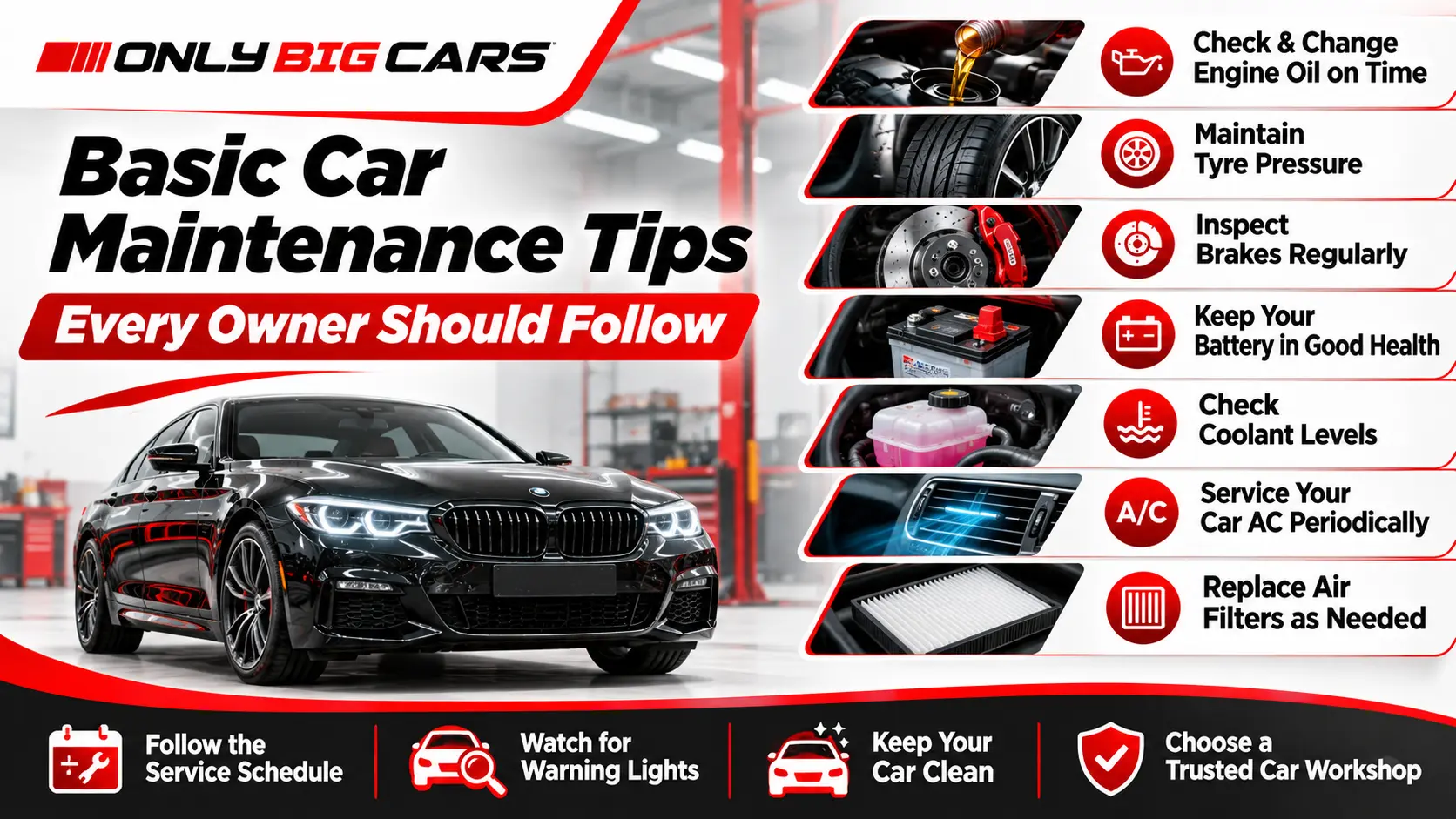
Owning a car comes with the responsibility of maintaining it properly. Whether you drive every day for work, use your vehicle for family trips or take occasional long journeys, regular maintenance is essential for keeping your car in good condition.
Many vehicle problems develop gradually. Low engine oil, worn brake pads, incorrect tyre pressure, a weak battery or neglected filters may not cause immediate trouble, but ignoring them can lead to expensive repairs and unexpected breakdowns.
The good news is that basic car maintenance does not always require complicated technical knowledge. Understanding a few essential checks and following your manufacturer's recommended service schedule can help you take better care of your vehicle.
In this guide, onlybigcars shares practical car maintenance tips every owner should follow to maintain vehicle performance, improve reliability and avoid unnecessary repair expenses.
1. Check Your Engine Oil Regularly
Engine oil is one of the most important fluids in your vehicle. It lubricates moving engine components, helps manage heat and carries away contaminants.
Driving with insufficient, degraded or unsuitable engine oil can affect engine protection and performance.
Make engine oil inspection part of your regular maintenance routine.
What you should check:
- Engine oil level.
- Oil condition, where it can be assessed reliably.
- Signs of oil leakage.
- Whether the correct oil specification is being used.
- Whether an oil replacement is due according to the service schedule.
Always follow the manufacturer's instructions when checking engine oil. Some vehicles require specific procedures or electronic oil-level monitoring.
Do not rely only on the oil's appearance to decide whether it needs replacement. Follow the recommended oil specification and service interval.
If you notice repeated oil-level drops or visible leakage, arrange a professional inspection.
2. Replace Engine Oil and Filters on Time
Replacing engine oil at the recommended interval helps maintain proper lubrication and engine cleanliness.
The oil filter also plays an important role by capturing contaminants circulating through the lubrication system.
A delayed oil change or neglected filter replacement may affect the engine's long-term condition.
When booking an engine oil service near me, make sure you understand:
- Which engine oil specification is recommended.
- Whether the oil quantity is correct.
- Whether the oil filter replacement is included.
- Whether the replacement interval follows manufacturer guidance.
- Whether the quotation includes labour and applicable taxes.
Do not assume every vehicle requires an oil change at the same kilometre interval. Maintenance requirements vary by vehicle, engine, model year, oil specification and driving conditions.
3. Maintain Correct Tyre Pressure
Tyres are your vehicle's only direct contact with the road. Their condition and pressure can influence handling, braking, ride comfort and fuel efficiency.
Incorrect tyre pressure may cause uneven wear and affect vehicle stability.
Check your tyres regularly for:
- Correct inflation pressure.
- Uneven tread wear.
- Cuts and visible damage.
- Sidewall cracks or bulges.
- Embedded objects.
- Tread condition.
Use the tyre pressure recommended by your vehicle manufacturer. You can generally find this information in the owner's manual or on the vehicle's tyre information label.
Check tyre pressure when the tyres are cold and avoid relying on visual appearance alone.
If you notice repeated pressure loss, have the tyre inspected for punctures, valve problems or other damage.
4. Inspect Your Brakes Regularly
Your braking system is one of the most important safety systems in your car.
Brake pads, discs, fluid and other components need to remain in suitable working condition for dependable braking performance.
Ignoring unusual brake symptoms can increase safety risks and may lead to more extensive repairs.
Watch for these warning signs:
- Squealing or grinding noises.
- Vibration while braking.
- A soft or unusually hard brake pedal.
- Longer stopping distances.
- Brake warning lights.
- Vehicle pulling to one side during braking.
If you notice any of these symptoms, arrange a professional inspection.
A car brake service can help assess brake pad wear, disc condition, brake fluid and other relevant components.
Never postpone an inspection if braking performance has noticeably changed.
5. Keep Your Car Battery in Good Condition
The battery supplies electrical power required for starting the vehicle and operating various electrical systems.
A weak or ageing battery may cause starting problems, especially during extreme temperatures.
Basic battery maintenance includes:
- Checking battery condition.
- Inspecting terminals and connections.
- Looking for signs of corrosion.
- Checking charging system performance when required.
- Paying attention to repeated starting difficulties.
Modern vehicles may also require battery registration or coding after replacement, depending on the model.
If your car struggles to start repeatedly, do not automatically replace the battery without testing it. The charging system, electrical connections or other components may also be responsible.
6. Check Coolant Levels and the Cooling System
The cooling system helps maintain the engine's operating temperature.
Coolant circulates through the engine and radiator to manage heat. Low coolant levels, leakage or cooling-system faults can lead to overheating.
Make sure you:
- Check coolant levels according to the owner's manual.
- Look for visible leakage.
- Inspect hoses and connections when appropriate.
- Pay attention to temperature warnings.
- Use the correct manufacturer-recommended coolant.
Never open a radiator cap or pressurised coolant reservoir while the engine is hot.
If coolant levels repeatedly drop or the engine temperature rises above normal, arrange a professional inspection rather than repeatedly topping up without investigating the cause.
7. Maintain Your Car's Air Conditioning System
A properly functioning air conditioning system improves cabin comfort, particularly during hot weather.
However, AC performance can gradually reduce because of filter contamination, refrigerant leakage, airflow restrictions or mechanical faults.
Look out for:
- Weak airflow from vents.
- Insufficient cooling.
- Unusual noises when the AC operates.
- Unpleasant cabin odours.
- Inconsistent cooling performance.
The cabin air filter should be inspected and replaced according to the manufacturer's maintenance recommendations and its actual condition.
If the AC does not cool properly, a professional inspection can help identify whether the problem involves the refrigerant circuit, compressor, condenser, filters or electrical components.
8. Inspect Your Air Filters
Your car uses different filters for different purposes.
The engine air filter helps prevent dust and particles from entering the engine's intake system, while the cabin air filter helps filter air entering the passenger compartment.
Dirty filters can affect airflow and system performance.
Pay attention to:
Engine air filter: Check for excessive dust and contamination, especially if you regularly drive in dusty conditions.
Cabin air filter: Check for reduced ventilation airflow, unpleasant odours or visible contamination.
Other filters: Follow the manufacturer's recommended replacement schedule for fuel and other applicable filters.
Do not replace filters unnecessarily. Their condition and the vehicle's service schedule should guide replacement decisions.
9. Pay Attention to Dashboard Warning Lights
Dashboard warning lights are designed to alert drivers when a vehicle system requires attention.
Some warnings indicate routine maintenance requirements, while others may signal a serious fault.
Never ignore a warning simply because the vehicle appears to be driving normally.
For example:
- Oil pressure warnings require immediate attention.
- Engine temperature warnings may indicate overheating.
- Battery or charging warnings may indicate an electrical system problem.
- Brake warnings may indicate a braking system concern.
- Check engine warnings may require diagnostic investigation.
Refer to your owner's manual to understand the meaning of each warning.
If a red warning light indicates a serious issue, stop safely and follow the manufacturer's instructions. Do not continue driving when doing so could cause damage or compromise safety.
10. Keep Your Windscreen Wipers and Lights Functional
Clear visibility is essential for safe driving in different weather conditions.
Worn wiper blades may leave streaks or fail to clear rainwater properly.
Inspect:
- Front and rear wiper blades.
- Windscreen washer fluid.
- Washer spray operation.
- Headlights.
- Brake lights.
- Indicators.
- Reverse lights.
Replace damaged wiper blades when required and keep the lighting system in working condition.
Before long journeys, a quick check of the lights and wipers can help identify problems that might otherwise go unnoticed.
11. Follow Your Car's Recommended Service Schedule
Every vehicle has specific maintenance requirements based on its make, model, engine and manufacturing year.
Following the manufacturer's schedule helps ensure that important inspections and replacements are not overlooked.
A periodic car maintenance service may include:
- Engine oil and filter replacement.
- Brake inspection.
- Tyre condition assessment.
- Battery inspection.
- Coolant checks.
- Air filter inspection.
- Steering and suspension checks.
- Other model-specific maintenance tasks.
Not every vehicle requires the same work at every service.
Refer to your owner's manual or service documentation to understand the recommended maintenance schedule for your particular vehicle.
12. Maintain Your Car's Exterior and Interior
Maintenance is not limited to mechanical components. Keeping your vehicle clean also helps preserve its appearance and makes it easier to notice developing problems.
Exterior care:
- Wash dirt and road contaminants regularly.
- Clean the windscreen and windows.
- Inspect the paint for scratches or damage.
- Check for visible rust or corrosion.
- Keep lights and number plates clean.
Interior care:
- Clean seats and carpets.
- Remove accumulated dust.
- Keep the dashboard and controls clean.
- Check cabin ventilation.
- Avoid allowing moisture to remain inside the vehicle.
Use suitable cleaning products for your car's interior materials and exterior finish.
13. Listen for Unusual Sounds and Notice Changes in Performance
Your car may provide early warning signs through unusual noises, vibrations or changes in how it drives.
Do not ignore new or recurring symptoms.
Pay attention to:
- Knocking or rattling sounds.
- Unusual engine noise.
- Steering vibration.
- Grinding sounds while braking.
- Changes in acceleration.
- Unusual exhaust smoke.
- Fluid spots underneath the vehicle.
These symptoms can have different causes, so avoid assuming that a particular component is faulty without inspection.
A timely diagnosis can help identify the underlying issue and prevent unnecessary part replacements.
14. Keep a Record of Every Service and Repair
Maintaining service records makes it easier to track your vehicle's maintenance history.
It also helps technicians understand what work has already been completed.
Keep records of:
- Service dates.
- Vehicle mileage.
- Engine oil and filter replacements.
- Brake repairs.
- Battery replacements.
- Tyre replacements.
- Major repairs.
- Inspection findings.
Store invoices and service documents safely.
A complete maintenance history can also be useful when selling your vehicle because it helps demonstrate how the car has been maintained.
15. Get Your Car Inspected Before Long Journeys
Before travelling long distances, take time to check the important parts of your vehicle.
A pre-trip inspection can help identify problems before you begin your journey.
Consider checking:
- Engine oil and coolant levels.
- Tyre pressure and condition.
- Brake performance.
- Battery condition.
- Headlights and indicators.
- Windscreen wipers.
- Spare tyre and essential emergency equipment.
- Visible fluid leakage.
If your car has recently developed unusual noises, warning lights or performance problems, have it inspected before travelling.
For older vehicles or cars with an incomplete service history, a professional inspection may be particularly useful.
Basic Car Maintenance Checklist
Use this simple checklist to keep track of important vehicle maintenance tasks.
|
Maintenance item |
What to check |
|
Engine oil |
Level, specification and replacement schedule |
|
Oil filter |
Condition and replacement requirement |
|
Tyres |
Pressure, tread and visible damage |
|
Brakes |
Noise, pedal feel and component condition |
|
Battery |
Health, terminals and starting performance |
|
Coolant |
Level, leakage and correct specification |
|
AC system |
Cooling, airflow and cabin filter |
|
Air filters |
Condition and replacement schedule |
|
Lights |
Headlights, indicators and brake lights |
|
Wipers |
Blade condition and washer operation |
|
Service records |
Previous work and upcoming maintenance |
The frequency of these checks depends on your vehicle, driving conditions and manufacturer's recommendations.
Common Car Maintenance Mistakes Every Owner Should Avoid
Even careful car owners can overlook certain maintenance requirements.
Avoid these common mistakes:
Ignoring warning lights: Dashboard warnings should be investigated according to their urgency.
Delaying oil replacement: Follow the recommended service schedule instead of postponing necessary maintenance.
Ignoring tyre pressure: Incorrect inflation can affect tyre wear and vehicle handling.
Using unsuitable fluids: Always follow the manufacturer's fluid specifications.
Postponing brake inspections: Unusual noises or changes in braking response deserve attention.
Skipping periodic servicing: Regular maintenance helps identify developing issues.
Approving repairs without understanding them: Ask the workshop to explain the diagnosis, recommended work and estimated cost.
Forgetting service records: Keep invoices and maintenance details for future reference.
Why Professional Car Maintenance Matters
Basic checks help car owners understand their vehicle's condition, but some maintenance tasks require professional knowledge and appropriate diagnostic equipment.
A professional car workshop can inspect components that may not be easy to assess during routine visual checks.
When choosing a service provider, consider:
- Experience with your vehicle's make and model.
- Clear explanations of inspection findings.
- Transparent service quotations.
- Suitable replacement parts and fluids.
- Manufacturer-recommended maintenance procedures.
- Proper documentation of completed work.
If you own a premium or luxury vehicle, ask whether the workshop has experience with its specific diagnostic systems and maintenance requirements.
The objective is to choose a service provider that understands your vehicle and communicates clearly about the work required.
Conclusion
Basic car maintenance is an important part of responsible vehicle ownership. Regularly checking engine oil, tyres, brakes, battery, coolant, filters and AC performance can help you identify developing problems before they become more serious.
You do not need to be a professional mechanic to take better care of your vehicle. Understanding basic maintenance requirements, following the manufacturer's service schedule and responding to unusual symptoms can make a meaningful difference.
At OnlyBigCars, we believe that informed car owners can make better maintenance decisions and enjoy a more dependable driving experience.
Explore OnlyBigCars for car maintenance and repair information, and choose the appropriate service for your vehicle.
1. What are the most important basic car maintenance tips?
Check engine oil, tyre pressure, brakes, battery, coolant, filters, lights and wipers regularly. Also follow your vehicle manufacturer's recommended service schedule.
2. How often should I service my car?
Service intervals vary according to the vehicle make, model, engine, mileage and driving conditions. Follow the maintenance schedule provided in your owner's manual.
3. Why is regular engine oil replacement important?
Engine oil lubricates moving components, helps manage heat and carries away contaminants. Replacing it at the recommended interval supports proper engine protection.
4. How do I know if my car battery needs attention?
Slow engine cranking, repeated starting problems, battery warning indicators and electrical issues may indicate a battery or charging-system problem. A professional battery test can help identify the cause.
5. How often should I check my car tyre pressure?
Check tyre pressure regularly, preferably when the tyres are cold. Follow the pressure recommendations provided by your vehicle manufacturer.
6. What is preventive car maintenance?
Preventive maintenance involves inspecting, servicing and replacing components according to the manufacturer's schedule and their actual condition to reduce the risk of unexpected problems.