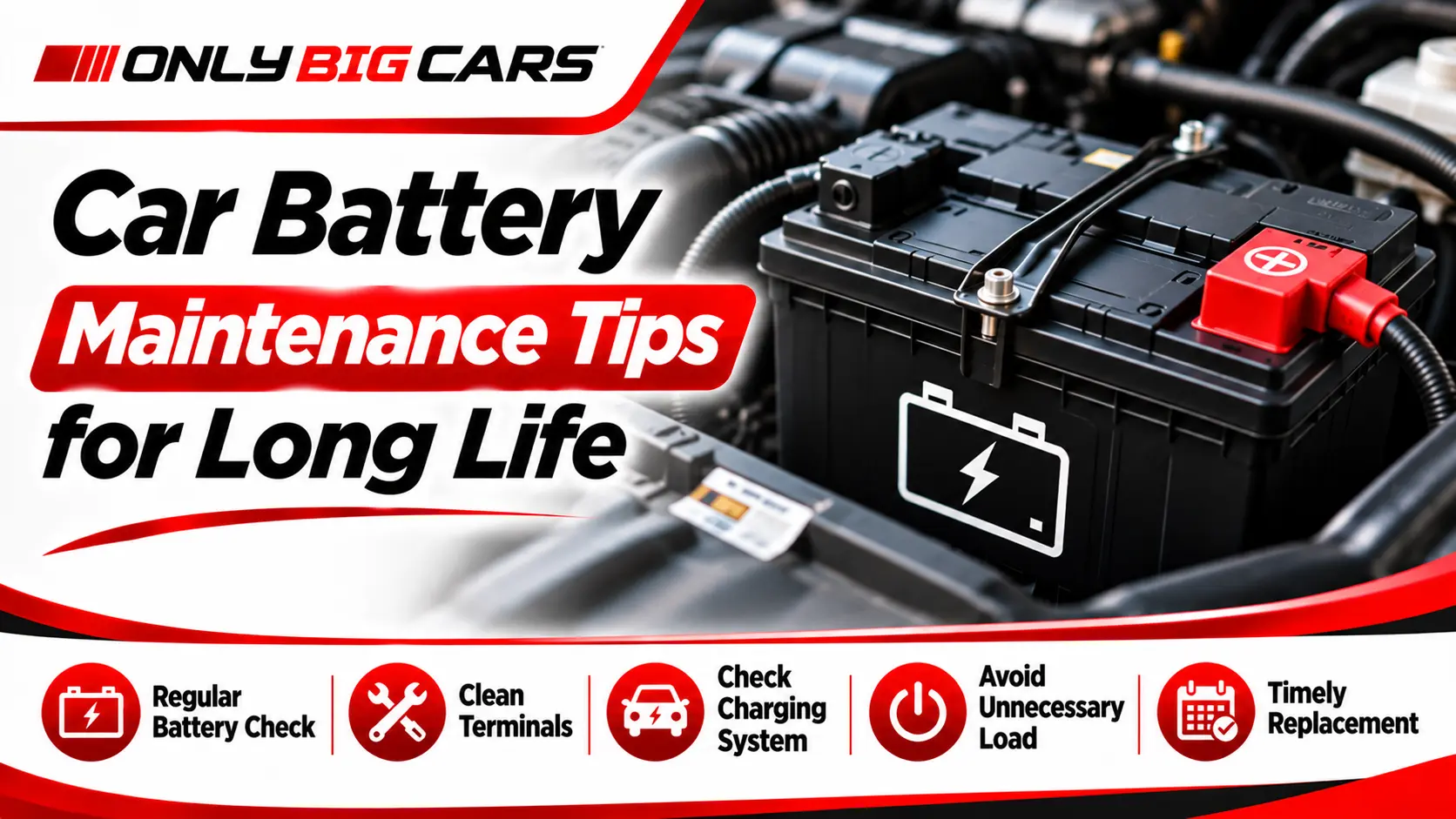
Your car battery plays an important role in the overall functioning of your vehicle. It supplies the electrical power required to start the engine and supports essential systems such as lights, electronic controls, infotainment and other electrical accessories.
However, battery performance can gradually decline with age, repeated use and changing driving conditions. A battery that is not properly maintained may struggle to start the vehicle or fail to provide reliable electrical power.
The good news is that regular inspections and a few sensible vehicle-use habits can help maintain battery condition and reduce the chances of unexpected starting problems.
In this guide, onlybigcars shares practical car battery maintenance tips, explains what affects battery health and highlights when professional inspection or replacement may be necessary.
1. Get Your Battery Condition Checked Periodically
A battery can gradually lose its ability to hold and deliver sufficient charge. Sometimes, this happens without an obvious warning until the vehicle starts experiencing starting difficulties.
Periodic battery inspections help assess its condition before a complete failure occurs.
A professional battery inspection may include:
- Checking the battery's overall physical condition.
- Testing its voltage and starting performance.
- Assessing its ability to hold charge.
- Inspecting the battery terminals and connections.
- Checking whether the battery is suitable for the vehicle.
Do not rely only on the dashboard battery symbol to judge battery health. A proper battery test provides more useful information about its condition.
2. Keep Battery Terminals and Connections in Good Condition
Battery terminals connect the battery to the vehicle's electrical system. Loose or corroded connections can interfere with electrical flow and cause starting or charging-related problems.
During routine servicing, the technician should check:
- Whether the battery connections are secure.
- Whether corrosion is present around the terminals.
- Whether the terminal clamps show signs of damage.
- Whether the battery cables are in good condition.
If corrosion or connection damage is found, have it addressed using the appropriate procedure. Avoid touching battery terminals or attempting repairs if you are unsure how to handle them safely.
3. Check the Alternator and Charging System
A healthy battery depends on a properly functioning charging system.
The alternator generally supplies electrical power while the engine is running and replenishes the battery's charge. If the alternator or related components develop a fault, the battery may not receive the correct charge.
Signs that the charging system needs attention include:
- A battery warning light on the dashboard.
- Headlights becoming unusually dim or changing brightness.
- Electrical accessories behaving inconsistently.
- Repeated battery discharge.
- Starting problems despite a recently replaced battery.
A battery warning light does not always mean the battery itself is faulty. The alternator, wiring, connections or other charging system components may be responsible.
A professional charging-system test can help identify the actual cause.
4. Avoid Leaving Electrical Accessories Running Unnecessarily
Electrical accessories can consume battery power even when the engine is switched off.
Depending on the vehicle, accessories such as interior lights, headlights, infotainment equipment and charging devices may contribute to battery discharge if left operating while parked.
To reduce unnecessary electrical load:
- Switch off lights when leaving the vehicle.
- Avoid leaving the infotainment system running unnecessarily.
- Check that interior lights switch off after the doors are closed.
- Remove charging accessories when they are not needed.
- Follow your vehicle's instructions for electrical accessories.
Modern vehicles may also have systems that continue consuming a small amount of power while parked. If the battery repeatedly discharges, a technician can check for abnormal electrical drain.
5. Be Mindful of Frequent Short Trips
Frequent short journeys can affect battery charging.
Starting the engine requires a significant amount of electrical energy. During very short trips, the alternator may not have enough operating time to replenish all the energy used during starting.
This does not mean every short journey will damage the battery. However, repeated short trips combined with high electrical usage may contribute to an insufficient state of charge.
If your vehicle is mainly used for short journeys and starts experiencing repeated battery issues, have the battery and charging system tested.
6. Pay Attention to Extreme Weather Conditions
Temperature can influence battery performance and service life.
In hot conditions, high under bonnet temperatures can accelerate battery aging. In cold conditions, a battery may deliver less starting power while the engine may require more effort to start.
To help manage weather related battery stress:
- Park in a shaded or covered location when practical.
- Follow the manufacturer's battery inspection recommendations.
- Get an ageing battery tested before demanding journeys.
- Investigate repeated starting difficulties rather than ignoring them.
A battery's condition and age matter more than relying on weather alone to predict when it will fail.
7. Keep the Battery Properly Secured
The battery should remain firmly positioned in its designated mounting area.
Excessive movement or vibration can place stress on the battery casing, connections and surrounding components.
During servicing, ask the technician to inspect:
- The battery holding bracket.
- Mounting points and fasteners.
- Signs of excessive movement.
- Physical damage to the battery casing.
A damaged or swollen battery should be inspected by a qualified technician. Do not attempt to open or repair a damaged battery yourself.
8. Understand Your Battery Type
Not every car uses the same type of battery. Different vehicles may require conventional flooded batteries, AGM batteries or EFB batteries, depending on their electrical requirements and start-stop technology.
Using an unsuitable replacement battery may affect vehicle operation and battery performance.
Before replacement, confirm:
- The correct battery technology.
- Required capacity and specifications.
- Appropriate physical dimensions.
- Correct terminal arrangement.
- Compatibility with the vehicle's charging system.
- Whether battery registration or monitoring-system reset is required.
Always follow the manufacturer's specifications rather than choosing a battery based only on price or appearance.
9. Follow the Correct Battery Maintenance Requirements
Some batteries are designed to be maintenance-free, while other types may have specific inspection requirements.
Do not assume every battery needs the same maintenance procedure.
For a maintenance-free battery, avoid opening sealed sections or adding water. For batteries that require periodic electrolyte checks, follow the manufacturer's instructions and have servicing performed by a qualified professional.
A professional inspection can establish which maintenance requirements apply to your vehicle.
10. Take Long Parking Periods Into Account
Leaving a vehicle unused for an extended period can allow its battery charge to decrease.
Even when the engine is switched off, certain vehicle systems may continue drawing a small amount of electrical power.
If you expect the car to remain parked for a long time:
- Follow the manufacturer's storage recommendations.
- Make sure the battery is in good condition before parking.
- Ask a technician whether a suitable battery maintenance charger is appropriate for your vehicle.
- Avoid disconnecting the battery unless the owner's manual or a qualified technician recommends it.
Vehicles with advanced electronics may require specific procedures when the battery is disconnected.
11. Recognise When Your Battery Needs Replacement
Battery maintenance can help support battery condition, but it cannot prevent normal ageing indefinitely.
A battery may eventually lose the capacity required to start the engine reliably.
Consider arranging a professional battery test if you notice:
- Repeated difficulty starting the engine.
- A battery that frequently loses charge.
- Electrical systems behave inconsistently.
- A battery casing that appears swollen or damaged.
- A battery that fails a professional health test.
Replacement should be based on the battery's tested condition and the vehicle manufacturer's specifications, not simply on an assumed universal replacement interval.
12. Keep a Record of Battery Inspections
Maintaining a record of battery checks can help you understand how its condition changes over time.
Keep details such as:
- Battery installation date.
- Battery type and specifications.
- Inspection and test results.
- Charging-system inspection history.
- Any previous electrical repairs.
- Battery replacement details.
These records can help technicians make better maintenance recommendations during future visits.
Common Car Battery Maintenance Mistakes
|
Common mistake |
Why it matters |
|
Ignoring repeated starting problems |
May allow a battery or charging-system issue to continue |
|
Overlooking terminal corrosion |
Can affect electrical connections |
|
Ignoring the battery warning light |
The charging system may need inspection |
|
Leaving accessories running |
Can contribute to unnecessary battery discharge |
|
Choosing an incompatible replacement |
May affect vehicle electrical system performance |
|
Ignoring long periods of inactivity |
Battery charge may decrease while parked |
|
Replacing the battery without testing |
The actual problem may be in the charging system |
Avoiding these mistakes can make battery maintenance more effective and help identify problems before they cause unexpected inconvenience.
When Should You Visit a Professional Car Battery Service Centre?
A professional inspection is recommended when your vehicle experiences repeated starting problems, unexpected battery discharge or electrical irregularities.
When searching for Car battery service, consider a workshop that can provide:
- Battery health and load testing.
- Charging system inspection.
- Alternator performance checks.
- Battery terminal and connection inspection.
- Electrical drain diagnosis when required.
- Correct battery replacement recommendations.
If the battery is no longer performing within the required specifications, a technician can recommend a compatible replacement.
At OnlyBigCars, vehicle owners can explore professional car maintenance and battery service support to help maintain their vehicles' electrical systems.
conclusion
A car battery requires more attention than simply replacing it when the vehicle refuses to start. Periodic inspections, healthy charging system performance, secure connections and sensible electrical usage all contribute to better battery care.
Although no maintenance routine can make a battery last forever, understanding its condition and addressing problems early can help reduce unexpected starting issues.
Make battery inspections part of your regular Car preventive maintenance routine and follow the specifications recommended by your vehicle manufacturer.
1. How can I maintain my car battery for a longer life?
Get the battery inspected periodically, maintain healthy electrical connections, check the charging system and avoid unnecessary electrical usage while the engine is switched off.
2. Does driving regularly help maintain car battery health?
Regular vehicle use can give the alternator an opportunity to replenish battery charge. However, very short journeys may not provide sufficient charging time. Battery condition should be checked if repeated discharge occurs.
3. Can a faulty alternator affect car battery life?
Yes. An alternator that does not charge correctly can leave the battery undercharged or cause charging-related problems. The charging system should be tested when battery issues occur repeatedly.
4. Do maintenance free car batteries require servicing?
Maintenance-free batteries generally do not require routine electrolyte top-ups. However, their condition, terminals, connections and charging performance should still be inspected according to the manufacturer's recommendations.
5. How do I know whether my car battery needs replacement?
Repeated starting difficulties, frequent discharge, physical damage or an unsuccessful professional battery health test may indicate that replacement is necessary.
6. Should I replace my car battery with the same type?
Use a battery that meets the vehicle manufacturer's specifications. The correct battery technology, capacity, dimensions and compatibility with the charging system are important when choosing a replacement.